
Pugachev Mud Volcano & Tikhaya Bay — Sakhalin's Geological Wonders
Southern Sakhalin holds two geological spectacles rarely seen outside the circum-Pacific belt: the Pugachev mud volcano group near Maguntan village, where cold hydrocarbon-rich mud seeps and bubbles from dozens of active craters, and Tikhaya Bay — the "Quiet Bay" — whose basalt sea stacks and cobble beach face the open Sea of Okhotsk. One road, half a day each, the kind of day that makes people revise what they thought an island could look like.
About the excursion
Two geological extremes on southern Sakhalin: cold mud craters that bubble with hydrocarbon gas in a landscape that belongs to neither volcano nor swamp, then Tikhaya Bay's basalt sea stacks standing against the open Sea of Okhotsk. One full day, the kind that demands a second visit.
What you'll do
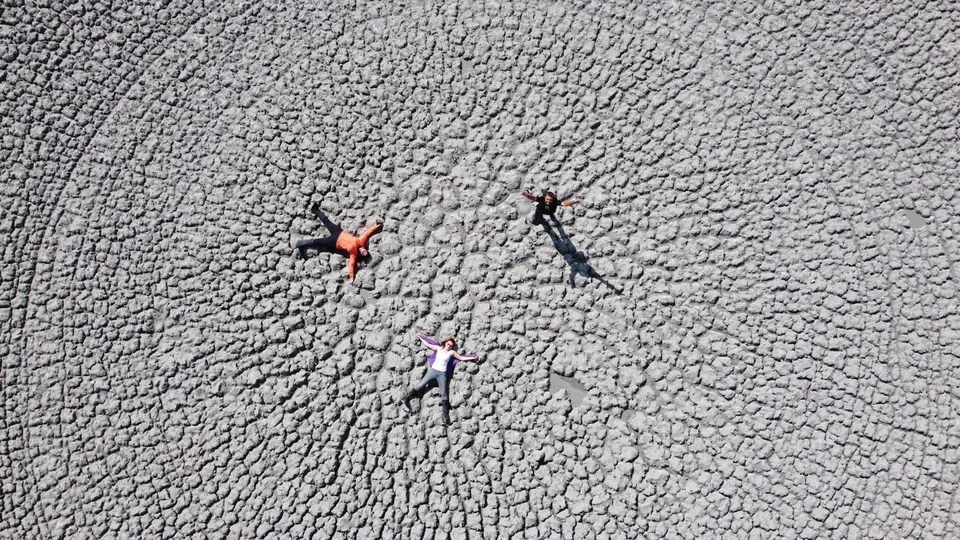
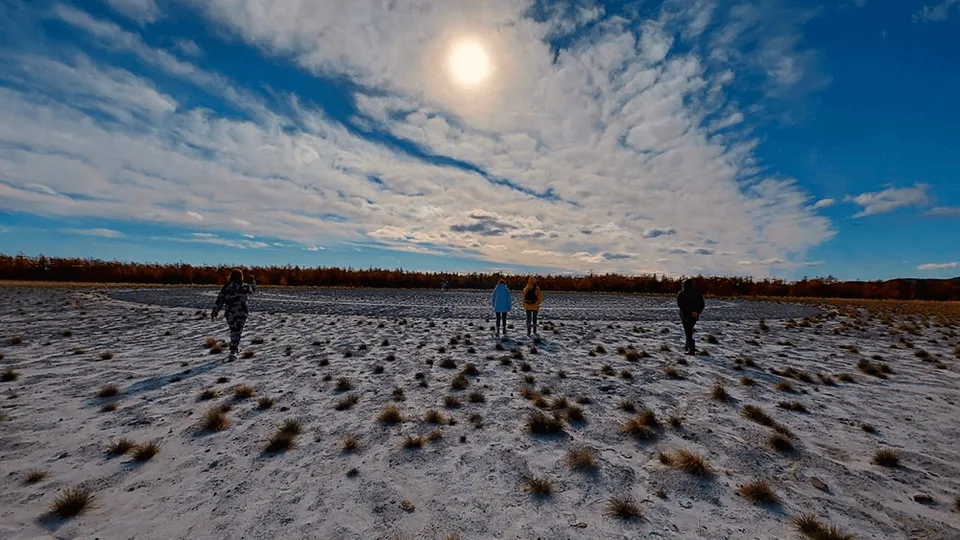
We depart Yuzhno-Sakhalinsk at 9:00 am, driving south toward Aniva and then east toward the Maguntan area. The Pugachev mud volcano group (Pugachevskiy Gryazevoy Vulkan) sits on a low ridge between agricultural fields and coastal forest, roughly 60 km from the city. These are cold mud volcanoes — not the lava-and-ash type — driven by the compression of deep sedimentary hydrocarbon deposits that force brine-saturated clay to the surface. The result is a field of grey-white craters, 15–30 cm in diameter, each gurgling and popping as gas escapes through the mud. The largest cone rises about 1.5 metres above the surrounding ground surface. The smell of methane and hydrogen sulphide is unmistakable but not overwhelming, and the geology is genuinely unlike anything most visitors have encountered: the mud maintains a constant low temperature even in summer heat, the craters migrate slowly across the field over years, and the surrounding vegetation is suppressed into a lunar-grey clearing in the forest. We allow 60–75 minutes here, with a full circuit of the active field and an explanation of the sedimentary geology of the Aniva Bay basin that produces these features.
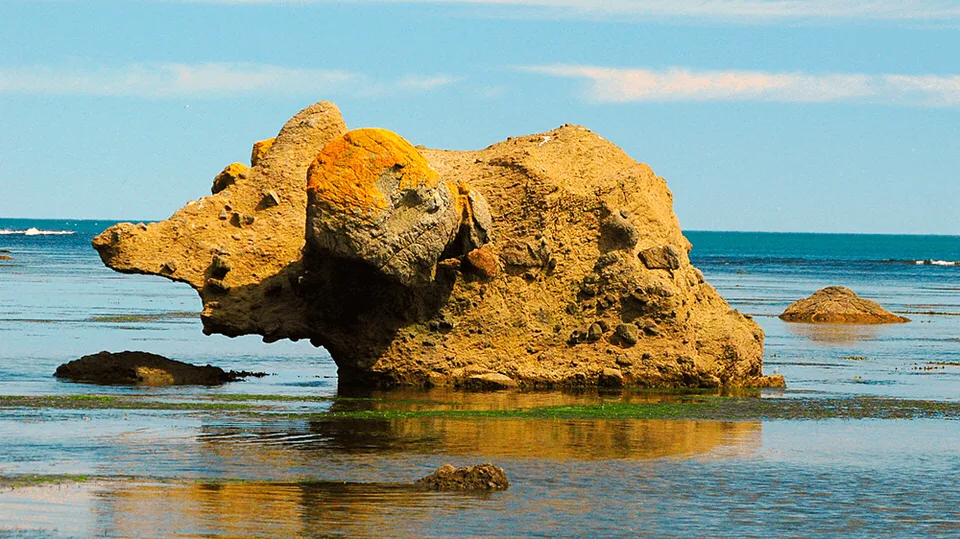
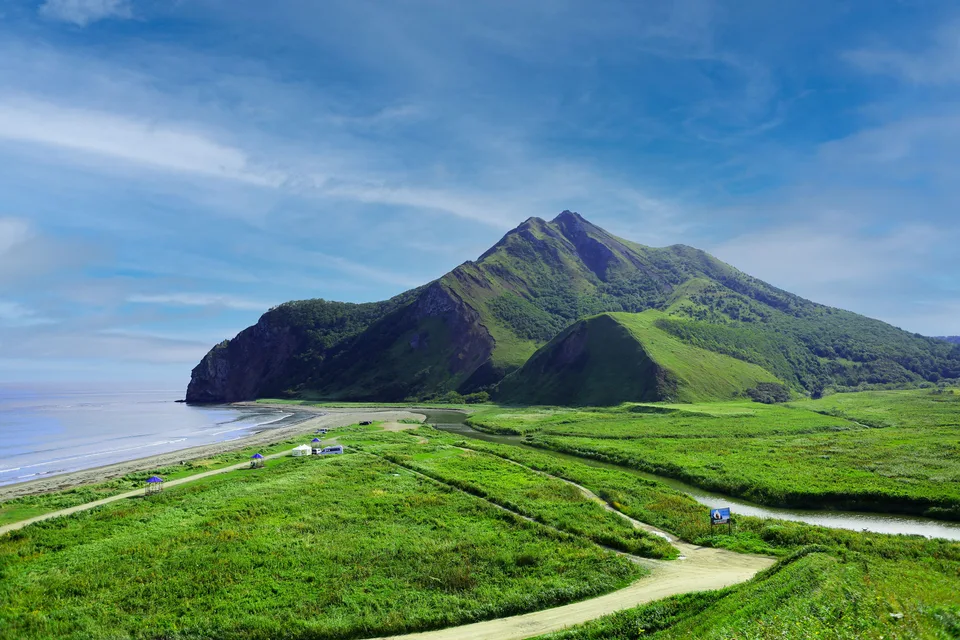
After lunch at a rest stop on the coast road — packed bento-style boxes with local smoked fish, rice, and pickled vegetables — we continue south to Tikhaya Bay (Bukhta Tikhaya, "the Quiet Bay"). Despite its name, Tikhaya is exposed to south-east swells rolling up from the Pacific across the Sea of Okhotsk, and the shore is energetic: a cobble beach backed by a low cliff, with sea stacks (kekury in Russian) rising from the surf at the bay's southern headland. The largest stack stands about 12 metres high, with cormorants and common murres occupying every horizontal ledge. The bay is also one of the few southern Sakhalin locations where the surrounding forest reaches to within metres of the shore, creating a transition zone used by Sakhalin brown bears as a seasonal fishing corridor; we brief guests on safe wildlife-awareness practice before the beach walk. We allow 75–90 minutes at Tikhaya.
Return to Yuzhno-Sakhalinsk by 7:30 pm via the coastal highway.
What makes it AMIST
The Pugachev–Tikhaya combination is not an obvious pairing, and that is exactly why we run it. The mud volcano field is scientifically significant — studied by Sakhalin State University geologists and included in regional natural heritage assessments — but it has no signage, no car park, and no trail. You will not find it without a guide who knows the turn-off and the safe walking circuit around the active craters. Tikhaya Bay is in a similar position: it appears on maps but the access track requires a high-clearance vehicle and the bear briefing is not a formality. This is a day for guests who have done the standard Sakhalin itinerary and want the layer underneath.
Practical notes
- Duration: ~10.5 hours door-to-door, pickup 9:00 am, return ~7:30 pm.
- Vehicle: High-clearance SUV or 4WD, max 6 passengers.
- Terrain: Paved road to Aniva area, then gravel and forest track to both sites.
- Included: hotel pickup and return, transport, guide, packed lunch with smoked fish, hot drinks.
- To bring: Waterproof boots (essential at mud volcano; mud does not wash off fabric), windproof jacket, old clothes you don't mind getting grey mud on, binoculars for sea stacks.
- Season: May – October. Mud volcano is active year-round but access track can be impassable November–April. Sea stacks best visited June–September when seabirds are present.
- Physical: ~4 km total walking on uneven ground. The mud volcano field has no paths — you walk on firm grass between craters.
- Wildlife note: Sakhalin brown bear presence at Tikhaya is seasonal (July–September). Our guide carries bear deterrent and will brief the group before the beach walk.
Sakhalin mud volcanoes: a primer
Mud volcanoes occur where deep sedimentary rock is under sufficient pressure to force the pore water, gas, and fine-grained matrix upward along fault lines or weak zones in overlying strata. Sakhalin's southern peninsula sits on the eastern margin of the Eurasian plate, above a series of Cretaceous and Palaeogene sedimentary basins that contain significant hydrocarbon accumulations — the same geology that made the Sakhalin-I and Sakhalin-II offshore fields economically viable. The Pugachev group is the most accessible and visually active of several mud volcano sites on the island. Scientists from Sakhalin State University have monitored the site for gas composition (predominantly methane with minor CO₂ and H₂S), temperature (constant 8–12 °C regardless of ambient), and crater migration rate (1–3 metres per year for the main cluster). The site is referenced in regional geological surveys conducted by the Far Eastern branch of the Russian Academy of Sciences.
Gallery
Upcoming departures
Choose a convenient date and book your spot
Pricing
Season: 01.06 — 31.10
| Тариф | Pricing |
|---|---|
| Excursion by запросуPrice рассчитывается под даты and состав группы | On request |