Sakhalin
2 photos
Belye Skaly (the White Cliffs of Iturup)
Twenty-eight kilometres of white-pumice cliffs on Iturup's Okhotsk coast — slot canyons and a graphite-coloured beach
Description
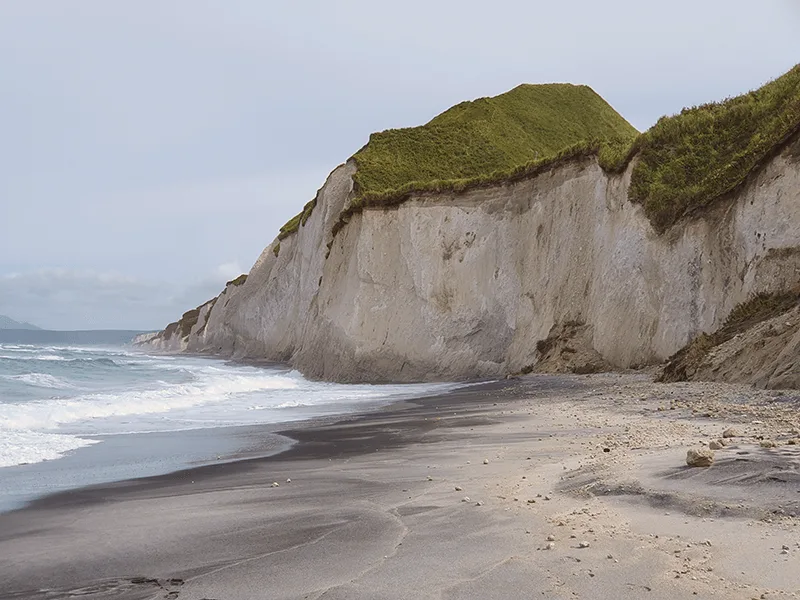
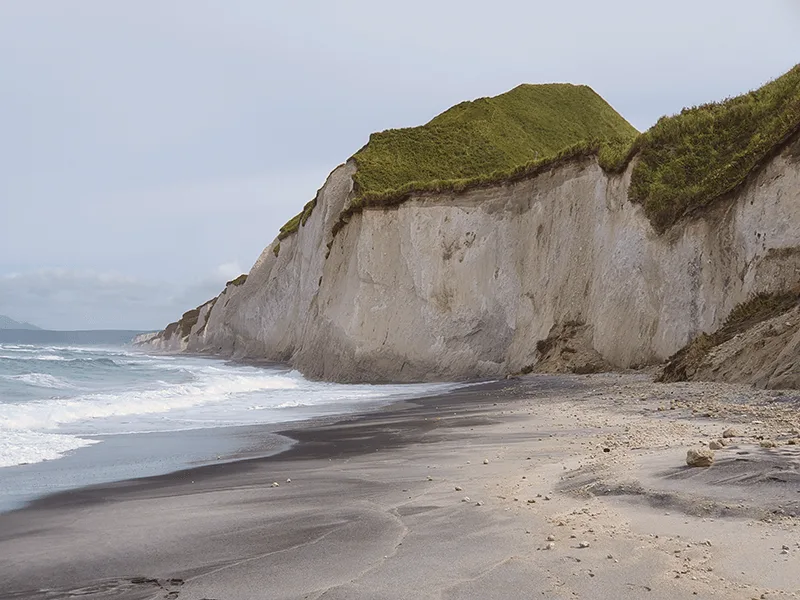
A 28-kilometre rampart of blinding-white pumice tuff on the eastern flank of Iturup, fluted into slot canyons and pouring down to a beach of crushed volcanic glass — Belye Skaly is the single most disorienting landscape in the Kurils. Within thirty seconds your eye stops trusting what it sees.
Geology: a lost caldera rendered in zeolite
The cliffs are the eroded edge of a Pleistocene pyroclastic flow — a thick sheet of welded pumice and zeolite-rich tuff erupted from the ancestral calderas that built the northern half of Iturup. The rock is extraordinarily soft — you can notch it with a fingernail — and almost pure white, shading to pale cream and lemon where iron oxides leach through. Along roughly 28 kilometres of the Sea of Okhotsk coast between Cape Iwanowski and the Slavnaya River, wind, rain and Pacific swell have carved the cliff into organ-pipe fluting, slot canyons and collapsed amphitheatres. Where the canyons open onto the shore, the beach itself is a graphic mosaic: gleaming white pumice grains from above, glossy obsidian shards and magnetite sand from the volcanoes of the island's spine.
The cliffs were largely unreported in the Western scientific literature until the Soviet expeditions of the 1960s–70s; tourism access opened only after civilian flights into Yasny airport, near Kurilsk, began in 2014.
What the visit is like
Access is from Kurilsk, Iturup's main settlement. A 4x4 transfer of roughly two hours — partly on the beach itself, timed strictly to low tide — delivers you to the foot of the cliffs. From there the walk is along the tideline, craning up at walls that rise 80 to 120 metres almost vertically. Side canyons invite detours: narrow, sun-bleached corridors that close overhead, floored with white sand so fine it squeaks. The contrast of the white rock against a slate Okhotsk sea and, on clear days, the smoking cone of Bogdan Khmelnitsky Volcano inland, is the image guests remember.
We plan four to six hours on the shore. It is not a technical hike — the route is essentially level beach — but it is entirely dependent on the tide window, and Iturup weather has its own arithmetic.
Practical information
- Access: Iturup is a border-control zone; permits are required (we handle the paperwork). Yuzhno-Sakhalinsk to Yasny airport: roughly 90 minutes by air. AMIST builds the multi-day programme around a stable weather window.
- Season: Late June through mid-September. Fog is least frequent in July–August; early autumn gives the cleanest light.
- Tides: The beach is closed at high tide. Visits run with a guide and a tide table — no exceptions.
- Bring: Sturdy hiking boots that can take a wading section; a windproof shell; polarised sunglasses (the cliff glare is fierce); sunscreen even on overcast days.
- Don't: Scratch, chip or remove tuff fragments. Belye Skaly is a protected natural monument of Sakhalin Region.
What makes Belye Skaly the flagship
Belye Skaly is the rarest landscape Russia can show you in a week — a Kuril Antelope Canyon under an open Pacific sky. AMIST has run Iturup itineraries since civilian flights to Yasny opened, with permanent partners in Kurilsk: permit handling, vehicles, tide planning. Groups capped at six, so the cliff frame stays yours.
Gallery
1 / 1
On the map
Want to see Belye Skaly (the White Cliffs of Iturup)?
We will arrange an excursion to this and other attractions