Island Shikotan
1 photo
Dimitrova Bay
A wild beach on Sakhalin's southwest coast — reachable only by 4×4
Description
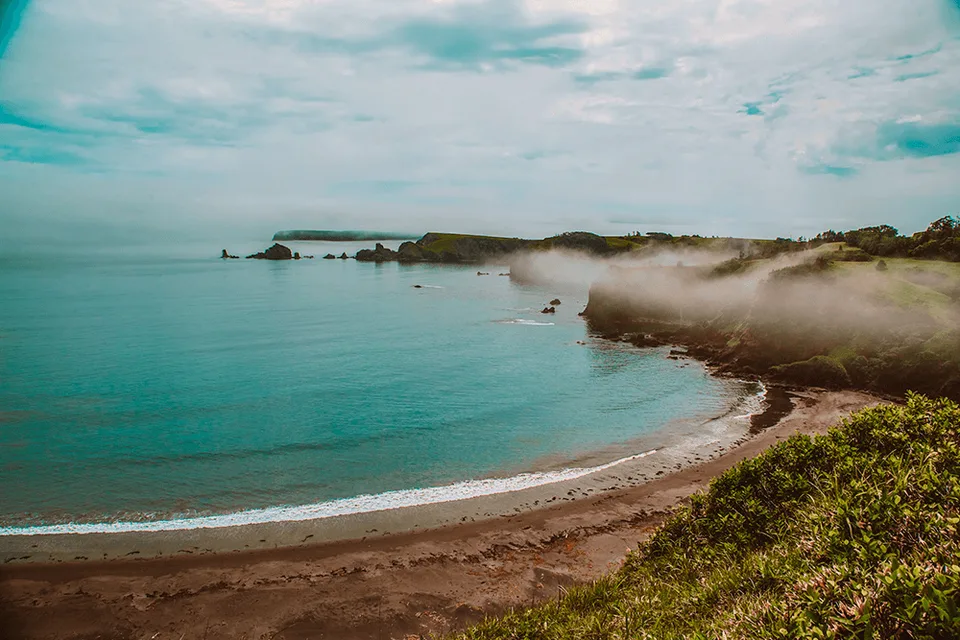
Dimitrova Bay is one of the last genuinely wild beaches on Sakhalin — a long arc of dark volcanic sand hemmed by forested bluffs, reachable only when road conditions and a capable 4×4 agree to cooperate. The Japanese, who held the island until 1945, knew it as Inemoshiri: a small homestead of three fishing families lived here, working cod for drying. All that remains of those people is an overgrown Japanese graveyard in the grass.
Where the road runs out
The bay sits on Sakhalin's southwest coast, roughly 180 kilometres south of Yuzhno-Sakhalinsk in the direction of Cape Krilon. The final section of track is unpaved and subject to seasonal flooding, which means access is effectively gated by the weather: passable from late May through mid-October in a good year, much narrower in a wet one. That restriction is precisely what keeps the bay as it is.
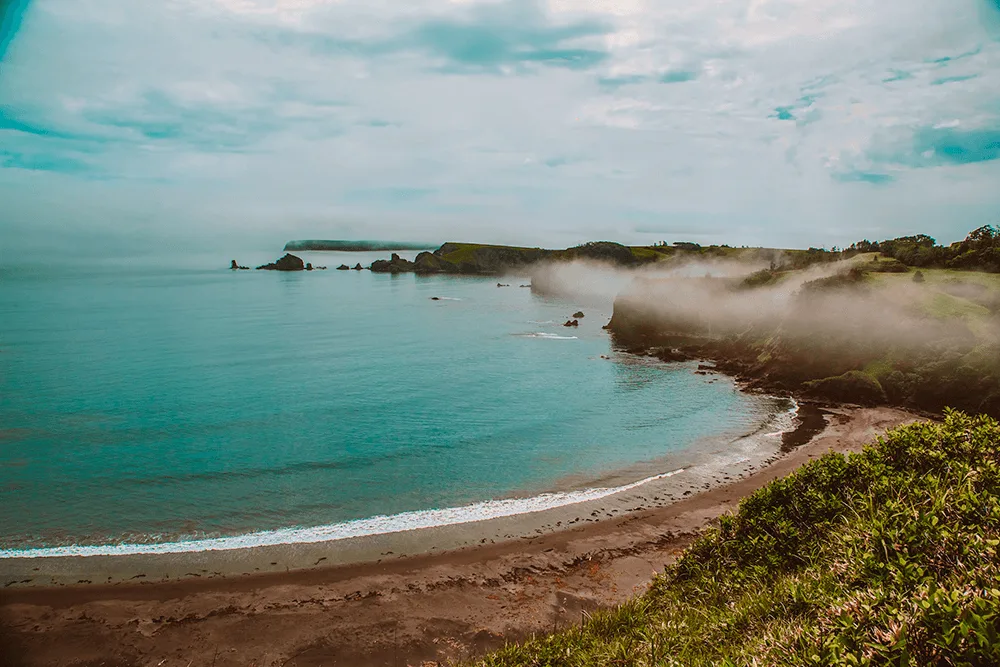
The approach through the mixed coastal forest — Sakhalin fir, stone birch, dense undergrowth — already signals that you are somewhere few tourists reach. The trees part without ceremony and the bay opens suddenly: a broad, gently curving beach backed by low cliffs, the Tatar Strait filling the horizon in shifting shades of grey and green.
A Japanese chapter, faintly visible
During the Japanese Karafuto period before 1945, a small settlement stood on the beach, working the inshore fishery. The settlement was closed after 1945; from the 1960s into the 1980s the site held a Soviet border post, complete with a stable, patrol dogs and tracked vehicles. Japanese fishing schooners caught by storms could put in here without customs formalities for shelter or minor repairs. What remains today is the overgrown graveyard and the faint outline of foundations on the slope.
The beach itself
The sand is the dark basaltic variety typical of Sakhalin's southwestern shore — more pewter than gold, fine-grained, and cool underfoot even in July. The surf is mild by Sea of Japan standards, arriving in long, unhurried rollers that break well offshore. The water peaks at around 16–18 °C in August: cold enough to be invigorating. There are no facilities of any kind: no changing rooms, no vendors, no infrastructure. You bring what you need; you take everything out.
The northern headland offers a short scramble and an overlook of the bay. Pigeon guillemots and black-tailed gulls nest on the cliff faces; in summer, white-sided dolphins and harbour porpoises occasionally pass close inshore.
Practical information
- Access: 4×4 only; sedans don't make it. AMIST runs expedition jeeps with the geometry and tyres for the route.
- Drive: 3–3.5 hours each way from Yuzhno-Sakhalinsk, with two river fords. The drive through coastal taiga is part of the experience.
- Season: July–August warmest; late May–early June for wildflower hillsides and emptiness; September for gold light and atmospheric sea fog.
- Bring: Layered windproofs (the bay funnels onshore wind), waterproof boots for the fords, a wide-angle lens for landscape and a long lens for wildlife. AMIST tours include water and lunch.
- Stay: Currently a day trip from Yuzhno-Sakhalinsk. On request we build a 2–3-day route combining Dimitrova with Cape Krilon and Tikhaya Bay.
The logic of this route
Sakhalin has hundreds of kilometres of coast, but there is little of it left in this state — unbuilt, uncrowded, and requiring effort. Dimitrova is the kind of place that recalibrates what the word "beach" means. AMIST has worked the southwest coast since the early 2010s — we know which ford is passable in a wet July, which bypass shaves ten kilometres, and where not to leave the wheel-line. That local difference between adventure and problem is what a guide is for.
Gallery
1 / 1
On the map
Want to see Бухту Димитрова?
We will arrange an excursion to this and other attractions