
Sakhalin
1 photo
Cape Kuznetsova
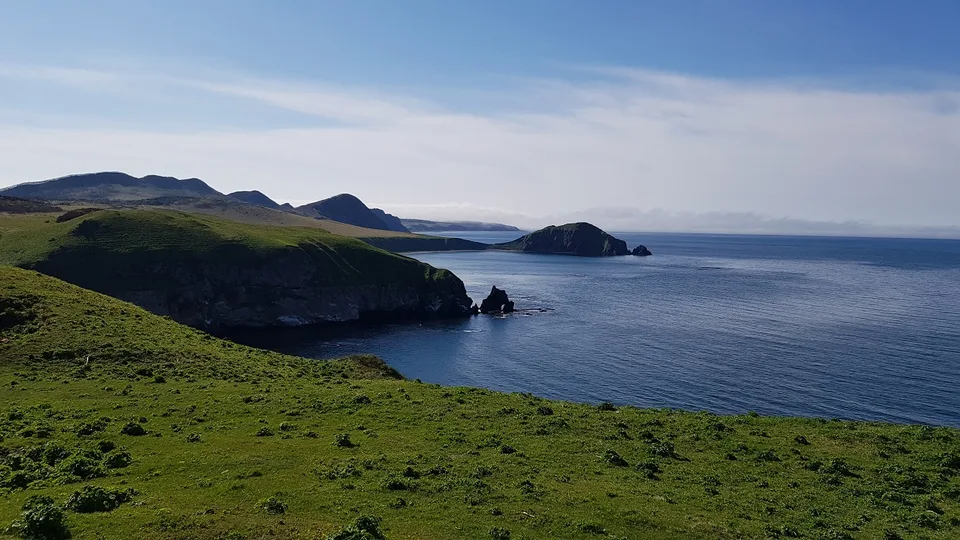
A protected headland on the western Krilon Peninsula — Sakhalin's only year-round wild sea lion and seal haul-out
Description
Cape Kuznetsova is one of the outermost points of the Krilon Peninsula — a long, narrowing finger of southwest Sakhalin that extends toward the La Perouse Strait. Where the peninsula tucks back northward, this headland holds its position against the Sea of Japan, exposed and largely undisturbed. It is a Sakhalin Region natural monument, with rare flora and an established seabird and pinniped colony.
The name
The cape is named for Captain First Rank D. I. Kuznetsov, who commanded the first detachment sent to the Russian Far East in 1857 to guard the imperial frontier. It lies in the Nevelsk District on the south-western shore of the Krilon Peninsula, about 130 km north of Yuzhno-Sakhalinsk. The protected area takes in a flat upper plateau and the cliff sea-walls below, which carry rare plants and bird colonies.
The Krilon Peninsula coastline
The Krilon Peninsula (Poluostrov Krilon) forms the entire south-west corner of Sakhalin Island, tapering to a rocky tip at Cape Krilon roughly 43 km across the La Perouse Strait from Hokkaido. Cape Kuznetsova sits on the western flank of the peninsula, where the coast faces the Sea of Japan and the exposed open fetch from the south and west. The headland itself is dark volcanic rock — the same lithological character as much of southwestern Sakhalin — rising in rough ledges from the intertidal zone to a blunt clifftop.
The atmosphere here is distinct from the more photographed south-eastern shore. No tourist facilities, no established paths, and in most seasons no other visitors. The coast is defined by raw geology: eroded black rock shelves, sea-stacks offshore, kelp beds visible through clear water at low tide, and a persistent swell. Spectacled guillemots and several gull species nest on the offshore stacks and the cliff ledges.
The cape's headline natural feature is the only year-round wild Steller sea lion and seal haul-out on Sakhalin, both species listed in the Russian Red Data Book. The animals are visible from a distance and unmistakably loud — explosive exhalations, columns of spray as they surface, and continuous activity around the rocks. Unlike the urban Nevelsk port colony nearby, the Kuznetsova haul-out is wild and uses natural rock.
The approach
There is no road to Cape Kuznetsova. The route south through the Krilon Peninsula from Nevelsk — the nearest substantial town — passes coastal forest and tide-dependent river crossings. A high-clearance 4WD is the minimum requirement; the final stretch to the cape involves beach driving and a short scramble on rough coastal terrain.
The cape is typically visited as part of a multi-day Krilon Peninsula expedition, paired with Cape Krilon at the southern tip. Both share the same FSB border-zone permit and the same logistics, so combining them is the natural format. Our drivers run the peninsula's tide-driven driving regime as routine.
Practical information
- Permit: The Krilon Peninsula is a border-controlled zone; an FSB pass is required. AMIST handles applications — allow 30–60 days, carry passport throughout.
- Season: Mid-June through mid-September. Outside this window the peninsula's beach sections are impassable.
- Format: 4WD expedition from Yuzhno-Sakhalinsk via Nevelsk and Shebunino, typically 2–3 days with camping or basic base accommodation; usually combined with Cape Krilon.
- Terrain: Coastal ledges and beach sections require sturdy waterproof boots; the cape itself includes minor scrambling on volcanic rock.
- Bring: Full waterproof outer layer, warm mid-layer (the Sea of Japan stays cold even in midsummer), sturdy boots, polarised sunglasses and a tele lens for birds and the sea lion haul-out.
What Kuznetsova shows
The Krilon Peninsula is one of the least-visited coasts in the Russian Far East, and Cape Kuznetsova sits at its quietest end. If Cape Krilon is the terminus — the famous endpoint with the lighthouse and the Hokkaido view — Kuznetsova shows the unedited face of the peninsula: raw shoreline, volcanic rock, open sea, and a sea lion colony that stays here year-round. For guests who want the whole peninsula rather than one ticked landmark, this is what Kuznetsova delivers. AMIST has run Krilon expeditions long enough to know which tides to trust and which fords to bypass after rain, and that experience is the offer.
Gallery
1 / 1
On the map
Want to see Cape Kuznetsova?
We will arrange an excursion to this and other attractions