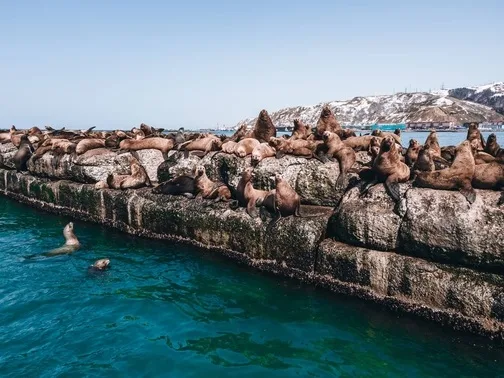
Sakhalin Island, and the Nevelsk district in particular, draws travellers and researchers with remarkable natural spectacles. Among the most striking is the Steller sea lion rookery — a gathering place of the largest member of the eared seal family, also known as the northern sea lion. These animals arrive on Sakhalin every spring and remain through June. Adult males can reach three metres in length and occasionally exceed one tonne in weight.
The Rookery at Nevelsk
A rookery is a coastal site where large numbers of sea lions congregate. In Nevelsk the animals have colonised the town's breakwater — a long wave-barrier built to protect the shoreline. Hundreds of sea lions rest there in the open air, basking in both sunshine and the cool coastal breeze. The site functions as a living community with its own rules and social customs.
The Nevelsk shoreline suits the animals well: easy access to the water, an abundance of flat rock surfaces across the entire breakwater structure, and a relatively calm tourist footprint — most visitors watch from a respectful distance. There are only three places in the world where Steller sea lions haul out in an urban setting like this: Nevelsk on Sakhalin, a site on Kamchatka, and one in Seattle, USA.
Behaviour and Social Hierarchy
Steller sea lions are social animals with a well-developed hierarchy. Every individual on the rookery occupies a defined rank, and disrupting that order rarely goes without consequence. Adult males hold the dominant positions. Their size alone commands authority, but they reinforce it with powerful vocalisations that carry across the beach.
Females and juveniles occupy less prominent spots and must stay alert to avoid drawing the attention of dominant bulls. Young males frequently spar with one another, honing the skills they will need when they eventually compete for leadership. Sea lions communicate through calls, posture, and direct physical contact. Bulls challenging for dominance roar loudly to discourage rivals, while younger animals play actively, learning both social and hunting skills.
Safety Rules for Visitors
Travellers coming to Nevelsk to observe sea lions should follow a few straightforward guidelines to avoid disturbing the animals and to stay safe. Despite an apparently calm demeanour, Steller sea lions can be dangerous. Their behaviour is unpredictable, particularly during the breeding season or when pups are present.
Keep your distance. Stay at least 100 metres from the rookery at all times. This lets you enjoy the spectacle without disturbing the colony. Bring binoculars or a telephoto lens to observe the animals in detail from a safe remove.
Do not feed the animals. Sea lions are fully capable of feeding themselves in the wild, and human food can harm them. Habituation to hand-feeding also disrupts natural behaviour and damages the wider ecosystem.
Stay away from pups. A pup that appears helpless may have its mother close by. Adult females — and males — will defend young without hesitation. Human scent left on a pup can also cause the mother to reject it.
Keep noise to a minimum. Loud sounds startle the animals, disturb the colony, and can provoke aggression. The most rewarding visits happen in near silence, listening to the natural sounds of the rookery and the sea.
Access to the breakwater itself is closed to protect the animals from human intrusion. However, sea lions can also be viewed from the water. Responsible ecotourism — guided excursions with strict safety protocols — makes it possible to observe these animals up close while supporting their protection. If you would like to arrange a guided visit to the Nevelsk sea lion rookery, AMIST offers a dedicated excursion.
Tour-Business Club AMIST.